
Creating a well-designed office no longer requires weeks of in-person meetings, costly site visits, or a large corporate budget. Online office interior design gives businesses of every size access to professional design expertise delivered entirely remotely — from initial brief through to a fully specified, contractor-ready result. For small businesses in particular, it has changed what professional design looks and costs.
This guide explains what online office interior design actually involves, why it works, and what to look for when choosing a service.
What Online Office Interior Design Actually Involves
The term online design covers a wide range of services, and it is worth being specific about what a professional offering should include. At Office Designer, our online service delivers the same outputs as a traditional in-person design practice — the only difference is the delivery method.
You share your floor plan, measurements, brief, and any reference images or brand guidelines. We return space planning drawings, 3D visualisations of key areas, a full furniture schedule with trade pricing, material and finish selections, and lighting design. The entire process is managed through digital communication — video consultations, PDF presentations, and annotated floor plans — without a single site visit required.
The result is a complete design package that is ready to hand to a contractor for pricing and construction. Nothing is left vague or approximate. Contractors receive the same standard of documentation they would get from a London design practice, because the output of good design does not change based on whether the designer visited the site.
Cost-Effective Without Compromising Quality
The cost difference between online and traditional in-person design is significant, and it is worth understanding where it comes from. Traditional design practices based in London carry substantial overheads — studio space, multiple site visits, physical presentation materials, and senior time spent travelling. These costs are passed directly to the client, typically through a percentage of project cost that runs at 10–15% of the total build budget.
Online design eliminates most of these costs without affecting the quality of the design work itself. The design is still done by qualified professionals using the same tools and producing the same standard of output. The saving comes from removing the logistics, not from reducing the expertise.
For a small business fitting out a 1,000 sq ft office, this difference is material. A traditional practice might charge £4,000–£8,000 for a design package on a project of that size. Office Designer’s online packages start from £799. The deliverables — space plans, 3D visuals, furniture schedule, specifications — are comparable. The cost is not.
There is also a procurement benefit that is rarely discussed. Designers with trade supplier relationships source furniture and materials at prices 20–40% below retail. For a small business buying workstations, chairs, and breakout furniture independently, those savings can offset the design fee entirely.
Accessible Regardless of Location
One of the most practical advantages of online design for small businesses is that geography is no longer a constraint. A business in rural Yorkshire, coastal Cornwall, or a regional market town pays the same as one in central London and works with the same designers producing the same quality of output.
Previously, businesses outside major cities faced a genuine choice: either pay London rates plus travel expenses, or work with local practices whose experience of commercial office design was more limited. Online design dissolves that trade-off entirely. The expertise travels digitally; the client does not need to.
This also means that businesses with multiple locations — or those relocating from one city to another — can maintain design consistency across projects without managing relationships with different practices in different regions. One design partner, one design language, regardless of where the offices are.
Faster from Brief to Completed Design
Online design processes move faster than traditional ones, for reasons that are structural rather than simply a matter of effort. When communication happens digitally, presentations can be shared and reviewed the same day they are produced rather than waiting for a meeting to be scheduled. Revisions are marked up on PDFs and returned within hours. Decision-making is not gated by diary availability.
For small businesses where time matters as much as cost — where a lease start date is fixed and a team needs to be operational — this pace difference is genuinely valuable. A design package that would take six to eight weeks through a traditional practice can often be completed in three to four weeks online, without any reduction in the quality or completeness of the output.
Faster design also means faster contractor pricing. Contractors quote against completed design documentation, not against concepts or mood boards. The sooner a complete package is available, the sooner the project can move into procurement and construction.
The Right Fit for Hybrid and Distributed Teams
The way small businesses use office space has changed substantially over the past five years. Many operate with teams that are partially remote, come into the office on a flexible basis, or use a mixture of home and commercial workspace depending on the day. Designing for this reality requires a different approach than the traditional assumption that everyone is in the office all the time.
Online design is inherently well-suited to this brief. The designers working on your project understand hybrid working patterns, desk sharing ratios, and the design principles that make an office worth the commute — because those principles have become central to commercial office design. A space that supports both focused individual work and genuine collaboration, that offers variety across the floor plate, and that reflects the company’s identity rather than feeling like a generic rental unit, is what encourages hybrid teams to actually choose to come in.
The design process itself models the kind of flexible, location-independent working pattern that many small businesses have adopted. Everything is managed remotely, on a clear timeline, with documented decisions and shared references. It fits naturally alongside the way modern businesses operate.
What a Good Online Design Service Should Deliver
Not all online design services are equivalent, and it is worth knowing what a professional offering should include before committing to one. The following are the outputs that a complete online office design package should produce.
Space planning drawings. An accurate, dimensioned floor plan showing the proposed layout with all furniture, circulation routes, and zone designations. This is the foundation of every other design decision and should be produced from your actual floor plan measurements, not estimated.
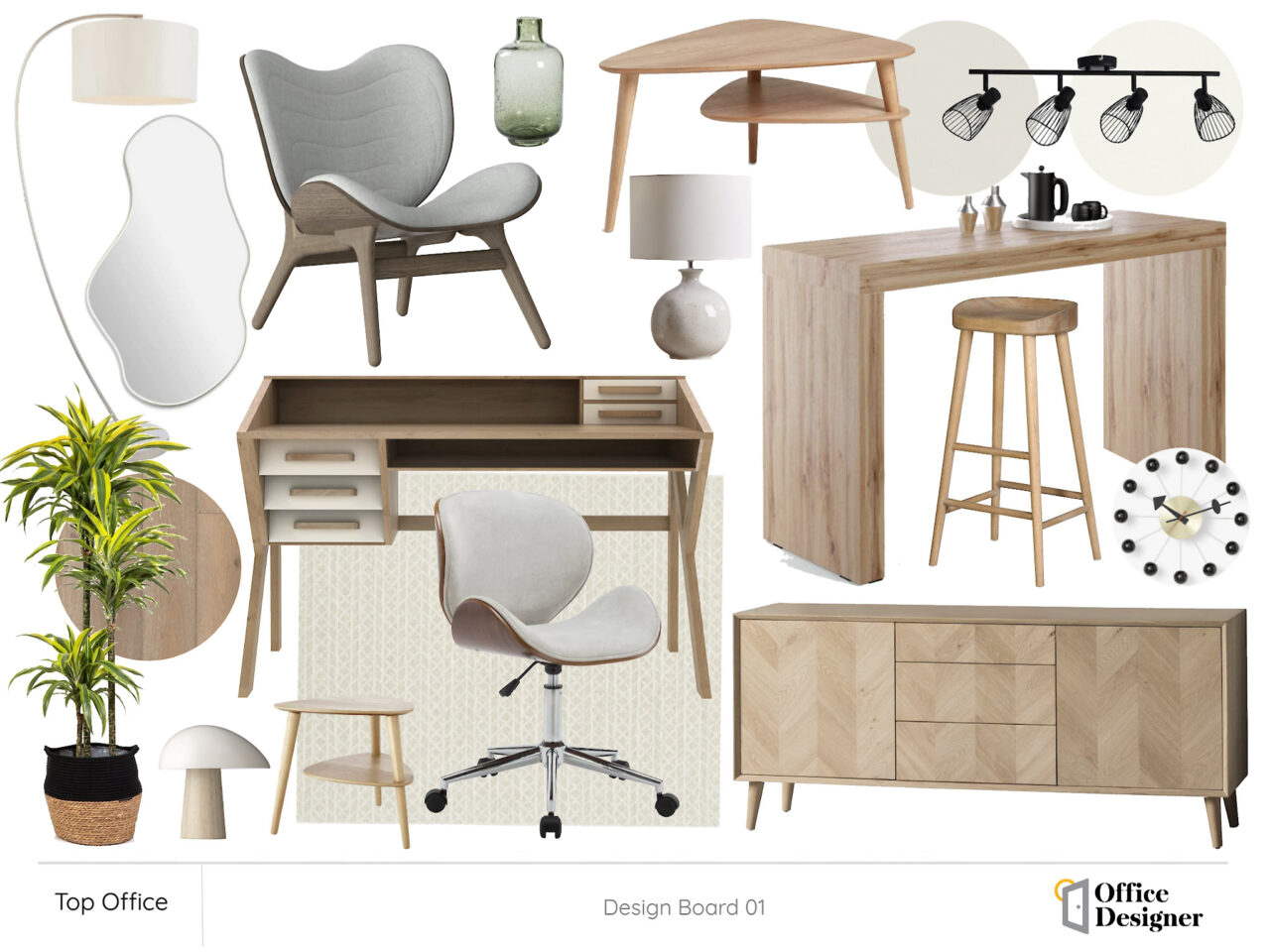
3D visualisations. Rendered views of the key areas — reception, main workspace, meeting rooms, breakout — that allow you to see spatial quality, material relationships, and lighting before anything is specified or ordered. Mood boards and reference images are not a substitute for actual renders of your space.
Furniture schedule. A complete itemised list of every piece of furniture, with supplier, product reference, dimensions, finish, and trade price. This document goes directly to the contractor and furniture supplier for procurement. A schedule that omits items or uses vague descriptions creates problems at the purchasing stage.
Material and finish specifications. Flooring, wall finishes, ceiling specification, joinery materials, and any specialist surfaces all need to be specified by product and supplier reference, not just described by colour or texture. Contractors price and build from specifications, not descriptions.
Lighting design. At minimum, a reflected ceiling plan showing luminaire positions and types, with specification references. For commercial spaces, lighting design is not optional — it affects both the visual quality of the finished space and its compliance with workplace lighting standards.
If a service offers mood boards and a shopping list but not the above, it is a styling service rather than a design service. For a small business investing in a workspace that needs to function professionally and stand up to contractor scrutiny, the distinction matters.
Ready to Transform Your Workspace?
Online office interior design is not a compromise on professional quality — it is a more efficient way to access it. For small businesses that need a workspace that performs, reflects their brand, and stays within budget, it is consistently the most practical and cost-effective route available.
Office Designer provides professional online office design services across the UK, with fixed-price packages starting from £799. Every package includes space planning, 3D visuals, a complete furniture schedule, and full specifications ready to hand to a contractor.
Book a free consultation to discuss your project, or explore our completed projects to see the standard of work we deliver. You can also read more about how we approach space planning and how the process works from brief to completed design.
About the author
Office Designer team
Commercial Interior Design Studio ·
Office Designer is a UK-based studio of qualified commercial interior designers specialising in workplace design. Our team brings together expertise in space planning, fit-out specification and workplace strategy, working with businesses across the UK to create offices that perform as well as they look.